
4 Core Email Marketing "Best Practices" for CPG Brands I’ve Abandoned (And What Actually Moves the Needle)
Pop-up signup rates, the welcome flow, testing everything and pre-purchase personalization: what I changed my mind about.

When I first started in email & retention marketing, I fell for the same myths as everyone else. I swallowed the standard agency advice whole: optimize for high pop-up conversion rates, obsess over the Welcome Flow, A/B test every CTA, and slice zero-party data into a hundred hyper-personalized paths.
It sounds brilliant on paper. It looks super sophisticated in theory. It’s also completely wrong for 95% of eCommerce brands :)
Over the years, after auditing and managing retention operations for mid-market and 8-figure DTC brands, my perspective has completely flipped. The traditional email playbook doesn’t just waste time, it actively distracts founders and CMOs from the real drivers of revenue and retention.
Here are the four traditional email marketing best practices I completely changed my mind about, along with the data-backed reality of how retention actually works.
1. The Pop-Up Signup Rate Myth
Old Thinking
The higher the signup rate, the better. If your pop-up signup rate isn't hitting at least 6% to 8%, your offer is broken, your copy is weak, and you're leaving money on the table.
The Reality
Today, I almost don’t care about the initial signup rate. I only look at the conversion-to-subscription ratio (how many of those opt-ins actually become paying customers). It’s ridiculously easy to artificially inflate your pop-up signup rate.
Offer a massive discount, run a massive cash giveaway, or promise the moon, and people will give you their email addresses. But what are you actually building? A bloated database full of cheap, low-intent leads who will never buy, will mark your emails as spam, and will ruin your deliverability over time.
- Quality traffic beats pop-up tricks: Your pop-up capture rate is almost entirely a function of your top-of-funnel traffic quality. If Meta is bringing high-intent buyers to your site, even a basic, 2-line pop-up will convert. If your traffic is cold window-shoppers, even the fanciest pop-up wont save you.
- Margin erosion: If Offer B gets a 20% conversion-to-subscription rate and Offer A a 20% conversion-to-subscription ratio, but Offer B gives away an extra 10% in margin (while converting the exact same number of actual buyers), Offer B is losing you money.
The Takeaway: Stop optimizing for submit rates. Optimize for the conversion-to-subscription ratio and protect your brand margins.
2. The Overhyped Welcome Flow
Old Thinking
The Pre-Purchase Welcome Flow is the single most critical flow in your account. You need a complex, 7-to-10 email sequence filled with brand storytelling, values, founder notes, and long-term nurturing.
The Reality
Data proves the Welcome Flow is usually the least important flow for building long-term retention. Look at your store’s purchase distribution data. For the vast majority of CPG, fashion, and DTC brands, over 85-90% of first-time welcome flow conversions happen on Day 0, often within hours of subscribing in the pop-up.
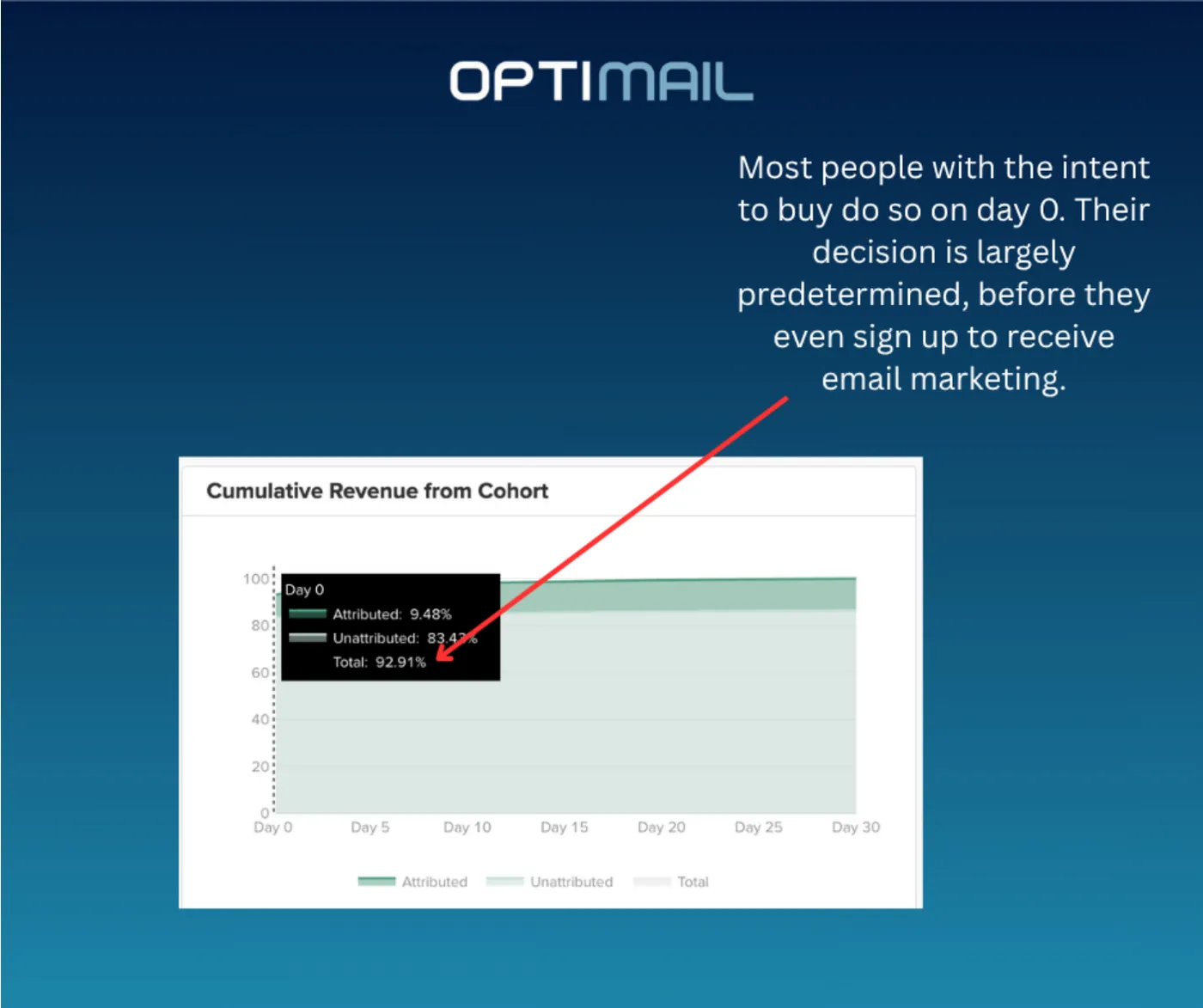
Most first-time buyers make their purchasing decision before they even enter their email into your pop-up. They saw your Meta ad, checked out your site, liked the product, and signed up specifically to get that 10% discount code you promised.
They don't buy because your 4th welcome email had brilliant storytelling. They buy because the intent was already built at the acquisition layer.
The first welcome email simply delivers the code and removes friction. The rest of the emails barely move the needle, and your data will confirm that.
Where the real money is made:
The true beauty of email marketing lies in turning one-time buyers into repeat customers, not taking credit for initial sales driven by paid media.
Instead of over-engineering pre-purchase flows, focus your strategy on post-purchase execution:
- Product onboarding and habit-building content (ensuring they actually use what they bought)
- Strategic cross-sells timed to consumption cycles
- Subscription churn - control Post-purchase objection handling
3. A/B Testing Everything
Old Thinking
Test everything. A/B test subject lines on every campaign, test CTA button colors, test images in your popups...
The Reality
Most things are simply not worth testing. They are low-leverage distractions that create busywork for your team while delivering 0 statistical significance or impact for the business.
Testing subject lines on a single campaign send to a list of 20,000 people gives you 0 reliable data. The sample size is too small, and the outcome is easily skewed by random noise. Besides, once that campaign is sent, you can never re-use that exact same subject line because each campaign is different.
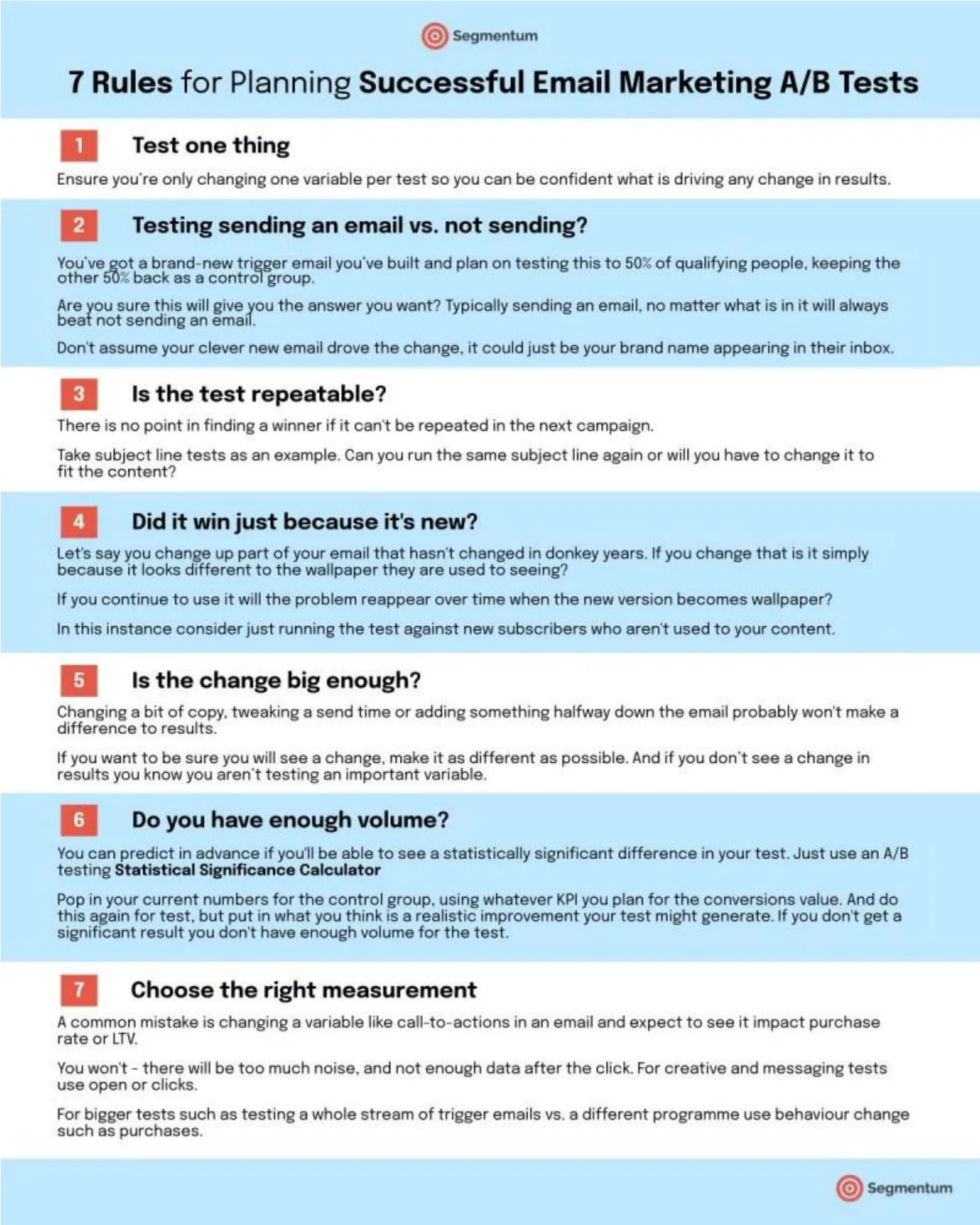
This checklist by Sean Duffy explains the AB testing philosophy perfectly:
Some of the things that are actually worth testing for CPG brands:
- Pop-up offer (for example 10% vs. $10 off)
- First welcome email structure & above-the-fold CTA placement
- Abandoned Checkout time delays & offer
- Core Angles in Automations (Us vs. Them, Reviews, Problem-Solution)
- Billing reminder headline and copy
4. Pre-Purchase Hyper-Personalization via Zero-Party Data
Old Thinking
Ask 6 questions in your pop-up (for example health goals) and route subscribers through 6 hyper-personalized welcome flow variations based on their answers.
The Reality
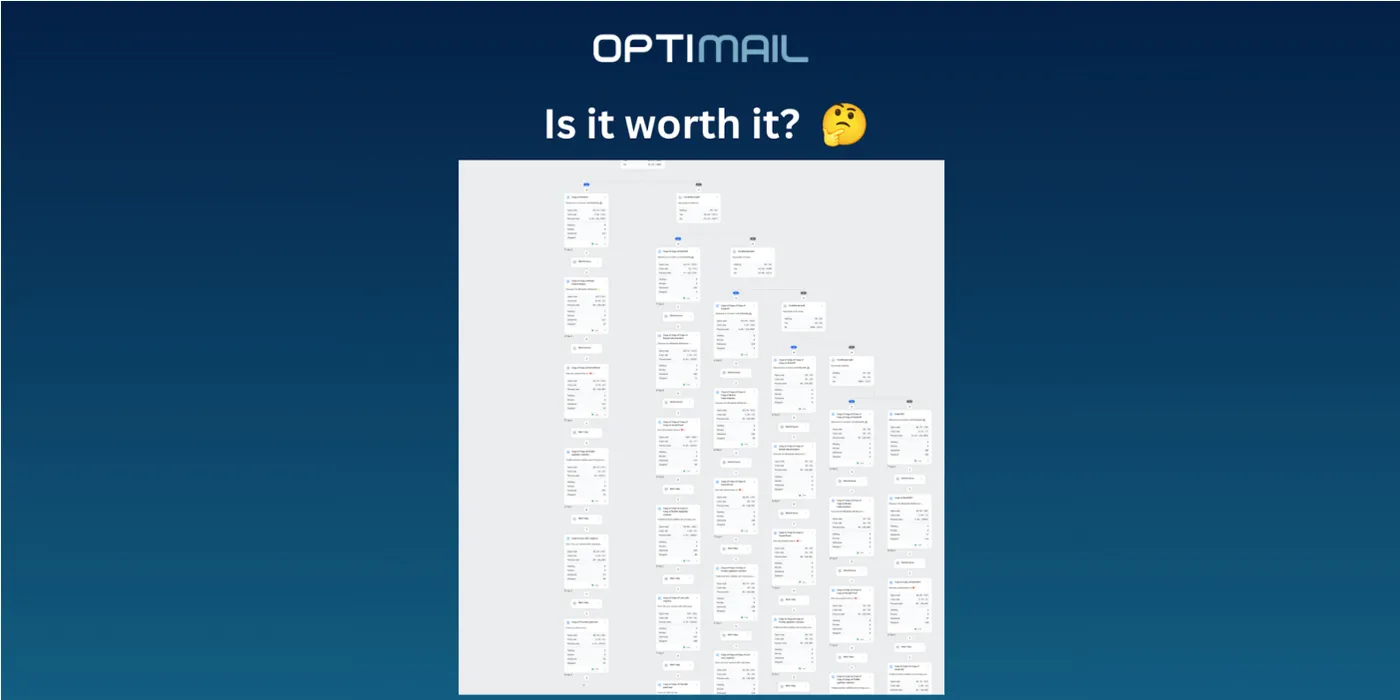
Unless you are a multi-9-figure brand managing dozens of broad SKUs, ultra-granular segmentation in email is a massive trap. It leads to bloated workflows, complex operational overhead, and nightmarish account management, all for a tiny, marginal bump in revenue (if any).
If you want to change an offer or update a logo later, you now have to edit 6 different paths instead of one. Not to mention that your traffic is now split into 6 paths which makes AB testing unnecessarily more complicated.
How to actually use Zero-Party Data:
Zero-party data is immensely valuable, but not for over-segmenting pre-purchase email automations.
Use that data for:
- Product Development: Identifying what problems your customers are trying to solve.
- Paid Ads Strategy: Informing your creative team about customer angles and pain points.
- On-Site Experience: Tailoring landing pages.
- Post-Purchase Experience: Deliver a personalized onboarding based on the customer's specific health goal. Here it actually makes sense to personalize because the person has already bought from you - now you just have to maintain that trust.
When it comes to email campaigns and core pre-purchase flows, broad, engaged segments win. Your job is to sell the click to the product page with clean, high-converting angles, not to play mad scientist with your ESPs flowchart builder.
The Big Picture: Email is Optimization, Not Magic
Email marketing is not the engine of your eCommerce business as some agencies like to say: acquisition and product market fit are the engine.
Paid ads bring the traffic, and a great product creates the brand. Email is the auto-tuning. It’s there to sell the click and educate once the purchase has been made.
We use email to influence retention, but if traffic is bad and product martket fit is not there, we can't expect it to work miracles.
Maintain top-of-mind awareness so that when a customer is ready to buy, your brand is the obvious choice.
Maximize customer LTV by delivering a stellar post-purchase experience.
Drop the unnecessary complexity, cut out the bro-science best practices you see on YouToube, and anchor your email strategy around basic human psychology and business fundamentals.